Showing posts with label toxicology. Show all posts

Thursday, April 8, 2010

UK Nanotechnology Strategy

The UK Nanotechnologies Strategy was published on 18th March 2010. It outlines the strategy of the current government, so things may change after May 6th - we'll have to wait and see!


Nano Strategy Fully Accesible Version - Final

The potential health risks from nanoparticles are one of the "emerging issues" that occupational hygienists and health and safety professionals in general need to keep abreast of. Nanotechnology is a fast developing field and the toxicological implications are not fully understood. Governments see nanotechnology as an important emerging technology that can lead to economic benefits and is encouraging its development. It's important that sufficient emphasis is given to research into the health implications.

One of the strategic aims set out in the strategy document is a commitment to

"Better understanding of the risks associated with the use of, and exposure to, nanomaterials, and enough people with the right skills to assess them. "
In respect to this aim the document sets out the following actions
  • Approaches to Government EHS research on nanotechnologies will be explored by the Chief Scientific Adviser network, with the aim of improving co-ordination. A meeting will be chaired by the Government Chief Scientific Adviser, John Beddington.
  • There will be an ongoing portfolio of Government and publically funded research into a wide range of crucial EHS nanotechnologies issues including the behaviour of key nanomaterials in the gut when eaten and when inhaled into the lungs.
  • Contributions will be made to international work programmes on nanotechnologies including the Organisation for Economic Co-operation and Development’s (OECD) Nanotechnology Working Parties and the EU’s Framework Programme. The UK will work to influence the future scope of these projects.
All commendable, if rather vague.

One of the problems is that its only possible to see an effect once exposure has occurred so there is a dilemma - how can we detect effects in humans without exposing them to possible dangers? Animal experiments present difficulties both in terms of transferability of the findings to humans and the ethical implications.

Until stronger evidence is available the only sensible approach is to be cautious and apply a high degree of control. Nano-particles may or may not have serious health effects - we don't know - but if we treat them as if they do and design our control strategies similar to those for carcinogens and sensitisers, then we should ensure that worker health risks are minimised.

Wednesday, February 24, 2010

n-hexane

There was an interesting article in the Guardian a few days ago about the use of n-hexane in a factory in China. The company in question, which produces touch screens fro companies including Nokia, was using the solvent to clean the screens.

N-hexane is one of the organic compounds we study on BOHS Module course M101 ”Effects of hazardous substances”. As an alkane, we wouldn’t expect it to be particularly toxic. Alkanes generally are mild irritants and narcotics (substances that cause depression of the nervous system leading to effects similar to drunkenness). N-hexane is different in that it has been found to have another more serious chronic (i.e. long term) effect. Exposure to the compound can lead to peripheral neuritis – damage to the peripheral nervous system – causing symptoms such as loss of sensation in the fingers. There’s a good summary on the effects of n-hexane here.

The effects on the peripheral nervous systems are not due to the substance itself, but one of it’s metabolites - hexane-2,5-dione. It’s an example where the bitransformation of a substance in the body produces a more toxic compound.
The harmful effects are well known, and in the UK, Europe and the USA companies with a commitment to the health and safety of their workers would avoid using n-hexane wherever possible. It seems that the Chinese company actually used n-hexane as a substitute for the less toxic ethanol. According to the Guardian report about 49 workers were affected. The problem could have been avoided if a serious attitude was taken to health and safety and the principles of occupational hygiene were applied.

Tuesday, January 12, 2010

What's a safe dose?

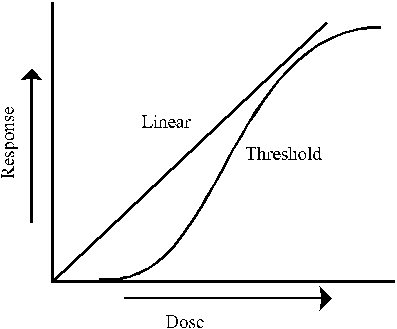
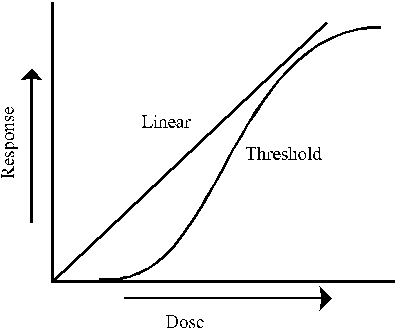
It was interesting to see an article in The Guardian yesterday discussing dose response relationships and threshold doses. Generally, increasing the dose of a substance increases the severity of the effect it causes. Similarly, for a given effect, due to individual susceptibility increasing the dose leads to an increase in the response – i.e. the number of people affected. For most substances, however, there is a threshold dose – that is a dose below which no-one is affected. This is because at doses below he threshold, the body’s mechanisms can deal with the substance, preventing harm. This can be represented graphically.

Typical dose-response curve showing a "threshold dose" (source:http://www.unido.org/index.php?id=5297)


With some substances, such as carcinogens and sensitisers, it is not possible to detect a threshold experimentally. It is argued that this is because they do not have one . The response is still dependant on the dose and at very low doses there are still some people who will be affected, albeit a relatively small number. Nevertheless, there is no “safe dose”. In such cases the dose-response curve is likely to be linear.

The Guardian article discusses the views put forward by an Oxford University physicist, Wade Allison, who has published a book in which he argues that there is a threshold for the effects of ionising radiation. He contends that DNA damage caused by exposure below this threshold dose can be repaired by the cells natural processes. This goes against the established view that radiation, like other direct acting carcinogens, has a dose response curve which doesn’t have a threshold, so that there is no identifiable dose below which adverse effects do not occur. Other radiation specialists are quoted in the article who do not support his view.

The difficulty with carcinogens is that at low doses it isn’t possible to accurately determine whether there is an effect. Cancer can be caused by many agents, including some related to lifestyle (e.g. smoking) and natural sources (e.g. background radiation from cosmic radiation and from rocks) and in reality we are normally simultaneously exposed to multiple agents. At low doses a carcinogen, such as radiation, is only associated with very low incidences of the disease. So it can be difficult to determine exactly what is the causative agent. If there is a threshold, it is likely to be very low, and detecting it would be difficult.

Saturday, April 4, 2009

Handel exhibition suggests his poison was the lead in his wine


I spotted an interesting article in the Guardian last week, reporting on a theory that the composer Handel suffered from lead poisoning


Lead acetate used to be used to sweeten wine and this is suggested as the source of lead exposure for the composer. I've even heard it suggested that the fall of the Roman empire could be attributed to the same reason as they, apparently, were very fond of sweet wine and used to add lead acetate to it. There is a useful summary of the history of lead exposure here on the USEPA website

Lead and its compounds are highly toxic. The main concerns are its chronic effects (due to long term exposure) particularly as it is accumulates in the body, remaining there for a long time after exposure.

Its principle effects include
  • anaemia,
  • irritability, tiredness,
  • effects on the nervous system leading to muscle weakness and, in extreme case, paralysis,
  • kidney and liver damage
  • gastrointestinal disturbances
  • effects on IQ, particularly in children
  • It is a teratogen, that is it can affect the unborn child when the mother is exposed, leading to spontaneous abortion, still birth or decreased birth weight,
  • fertility problems in males
Inorganic lead compounds are are also classified as "probably carcinogenic to humans" by
the International Agency for Research on Cancer (IARC)

For a thorough summary of its effects see the document Information on lead from the UK Health Protection Agency

Exposure to lead in the developed world has fallen dramatically due to increased awareness, stringent legislation in the workplace (such as the Control of Lead at Work Regulations in the UK), environmental regulation and the reduction of lead in products to which the general public could be exposed. The banning of lead in petrol being a particularly important measure. Consequently cases of lead poisoning are relatively rare.

However, it is likely that lead exposure is increasing in the developing world as lead and its compounds are still widely used in manufacturing and with the rapid growth of industry in India, China and other countries it is likely that the exposure of workers and the general public will increase. Control measures to reduce the exposure of workers and minimise emissions to the environmental are likely to be considerably less stringent in newly developing countries than in the developed world. A report by the World Health Organisation discusses these issues and concludes that:

"Public health measures should continue to be directed to the reduction and prevention of exposure to lead by reducing the use of the metal and its compounds and by minimizing lead-containing emissions that result in human exposures."


Monday, March 2, 2009

Nanoparticles

I came across the following video slideshow by Andrew Maynard (2020science.org), a researcher in nanotechnology. It's a nice, gentle introduction to nanoparticles and their properties.


Nanotechnology - Managing the Small Stuff, Explained from Andrew Maynard on Vimeo.


The key points he makes about these new materials are
  • the particles are small
  • they are "strange" - they don't behave how you might expect and the properties of a substance manufactured or created as a nanoparticle can be different than the same substance in the form of larger particles
  • they are "sophisticated" - in that they can be used to manufacture complex products with advanced uses

There are inevitable concerns about the toxicity of nanoparticles and the risks from exposure, both from an occupational and environmental context.

  • the small size of the particles means that they can, potentially, be absorbed easily into the body by inhalation AND skin contact (there is evidence that some particles can be absorbed through intact skin)
  • nanoparticles are much more likely to be absorbed into the blood via the lungs than their larger cousins. Once absorbed they can make their to other organs where they may be able to exert toxic effects.
  • their small size also means that they can be potentially absorbed into cells where larger particles of the same substance would not
  • the "strangeness" of nanoparticles means that it can be difficult to predict what their toxicological properties will be, even where there is a good understanding of the toxicity of larger particles of the same substance
  • In some cases, effects such as cancer are due to the physical form of particles and their Small size (aka asbestos fibres) rather than their chemical nature
It is too early to now whether any of these concerns are likely to be borne out in practice. However, its an area where a lot of research is taking place.

Wednesday, February 18, 2009

Introduction To Toxicology

This is an introductory presentation on toxicology.

I'll be using a slightly expanded version on day 1 of the M101 course that we are running in Chester next week.

Introduction To Toxicology
View more presentations from mikeslater.